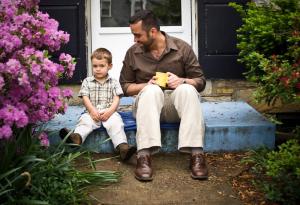
The Distinct, Positive Impact of a Good Dad
This Atlantic piece about good fathers hits it on all points.
The Distinct, Positive Impact of a Good Dad
This Atlantic piece about good fathers hits it on all points.
Last week while leaving the city, I saw a plump and placid-faced boy in a stroller shove animal crackers into his mouth like a hamster. My eyes welled up before I could process why. My kids – now 7 and eleven, and all arms, legs and bones – were that age just yesterday. It’s a bitter-sweet song, life – that my boys will always be my sons, but with each passing day, we lose our children to the inevitability of passing time.
It is a sentimental lie to believe otherwise.
I remember when my oldest son held his newborn brother, dwarfing him by comparison. I remember thinking, stunned, that he was just that small, like, yesterday. But in fact, three years had passed since big brother was such a bundle. Shocked at the passing of time, which slips by like thief in the night unnoticed, I vowed then to live each day in the present, and the rest be damned. And I have.
But alas, 7 years later, a chubby-cheeked kid with cookies reminds me of the sting from a thief called time.
There are no watchful vows to guard against the passing of time. No mindful eye that can save us the pain of watching our soft babies grow into stringy boys and eventually into grizzled and bristly men.
Time is the ultimate taker of our things, and leaves only age and fractal memories in its wake.
Time is a dark shadow, a relative of death. And a reminder of its purpose. I’ve always known this.
Many exhausted nights I crept into the boys rooms to see if they were still breathing. Quiet waves of relief washing over me as silent rising and falling tiny cotton-wrapped torsos slumbered peacefully.
I have green-nursery memories of standing there in tranquility, with nothing but a sleeping babe and the distant muffled hiss of central heating and the ticking of clocks, and all other muted and nagging reminders of life’s singular and irreversible direction.
Today, again, and thanks to a cracker-snacking toddler I’ll never know, I’ll forsake my high expectations, I’ll forgo enforcing the rules, and I’ll fall away from demanding anything resembling responsibility.
Just today, because it will be gone tomorrow, I’ll be soft – because soon tomorrow and every day after, these boys no longer will be.
Sunday morning.
I wake up late, lace up, and hit the bricks. Temps are in the 30s. I come in from my run, a cold and quick 5K.
The house is warm, quiet, and decked out thick in autumnal decoration. Old jazz standards seep out from a vintage radio in the dining room.
A breakfast plate waits for me on the counter, eggs and pancakes under steamy cellophane. Coffee’s on. Kids are reading. Kumi is up and about the house, making all things great in it.
Now nourished, I find time to write – and I do as I sip this bold cup of coffee with a splash of half and half. Sunlight streams to the den through dancing foliage and spills across the hardwood floor.
It’s here that I realize I have nothing to offer today but gratitude – and an honest prayer wishing all men everywhere my kind of Sunday morning.

18:43, Air battle pre-brief:
The specter of war hangs over the house like a noose. My lego AL-36 warship waits with maximum payload as the Resistance scrambles in the distance to affect a response. Amidst the frantic snapping of things together, they delude themselves with hope. Primary campaign is to afflict heavy damages on the enemy before the final inevitability of bath time.
So this is how it went down. Let me give you some background …
Philo knows that if he picks up a nasty new word in school, he should come to me – in private – and ask about it.
And he does, sometimes.
Sometime the words are really nasty – as in, like, four-letter-word nasty. Other times they are less offensive, but still inappropriate for his 6-year old brother to hear (and thus repeat)
So we’ve been over this a few times. If you want to know about it, ask me in private and I tell you everything I know about it. Period. No questions.
Tonight, mid dinner, he pipes up in front of everyone; Mom, Dad – and worst of all – his little bother.
“Dad, what’s a sissy?”
“OK,” I think – not a terrible word – but still not one I want inducted into our daily vocabulary.
I flash daggers right at him. He gets it, his brow furled in error admission. We just talked about this last night.
“In private!!
I swing attention to Hugh. Still fresh on his ear, It hasn’t set in yet – and I ask, “Hugh, why don’t you answer that one. Please explain to your big brother what [me, over annunciating] SIXTY is.”
He starts in, “Sixty is like a number, like six and zero. Sixty.”
Crisis averted.
But no – he continues …
“OR, it’s like, ‘hey, you sixty lady … “Sixty lady means naked lady.”
Silence.
Philo and I in syncopated unison, “where? did? you? hear? that?”
Hugh is six.
“From Philo,”he said.
Me: From Philo!?
Philo: What?!?! No!
Me: From Philo?
Hugh: Silence … [eyeballs swirling slowly]
I call his bluff and draw it out. He heard it on the bus (a different bus than the one he just threw his brother under)
Philo’s angry. Kumi stays out of it. Hugh picks at his dinner.
I hang my head.
I would have been fine with “sissy.”
Philo asked me tonight about great singers.
“To the You Tube!” I said.
We started with the Alpha, Freddie Mercury. “Bohemian Rhapsody” live, and then the vocals-only version of “Somebody to Love.”
Followed this with a sampling of Robert Plant, Eric Burdon, Chris Cornell, and tossed in Josh Groban to balance it out.
Kumi was home by that time. We solicited a few from her and got Sting “Every Move You Make” and the Howard Stern live version of Lady Gaga singing “Edge of Glory” unplugged. (See this is you haven’t!)
It was bedtime, so we wrapped with Kermit singing “The Rainbow Connection.”
We’ve barely scratched the surface.
The cat stands on two legs scratching violently at the sofa.
“Nova! Get down!” I shout from across the room making a sort of half gesture.
Hugh, 7 and seated on said sofa, looks up from a book and nonchalantly asks, “want me to give her some feedback?”
No – That’s ok, bud. But thanks.
A parent approached me on the field today early at practice. She was one of the first ones there. Her son is good. Sweet kid on the sidelines. A beast on the field.
She’s at every practice, every game, and has said maybe three words to me all season.
“I just wanted to say how appreciative I am that you stepped up to coach this year. You have been so great with these kids and I am just so grateful.”
She honestly gushed for about 3 whole minutes about the transformation she’s seen in her son.
I was speechless (you know that ain’t true!) But I was moved. She went on to say how much the team has grown this year and attributed it me. I told her, like I tell the team before, during, and after each win “It’s all them. They just show up and decide to play good soccer – whoever believes the most, wins.”
They hear that ten times a week verbatim.
That and, “Attitude trumps aptitude.” That’s our team motto.
Tomorrow and Sunday closes the season. Always humble and always sad. I’ll miss these kids. Until fall.
It was an ordinary, late-August day in 1988.
The sky was clear and blue.
It was summer vacation waning, the dog days ending. The air was cool and public pool crowds dwindled.
I was 9 years old, and I was melancholy at it all. Damn you, the passing of time and letting go of childhood wonder.
There was a distinct stillness in the air. A blend of anticipation, boredom, and dread known only to boys just before school days renew oppression on the wandering and free spirits of youth.
I’ll never forget this day.
It was when I first heard “Sweet Child O’ Mine,” on the radio. It lit something in me that never went away.
It’s amazing how a single song can hold such meaning and mystery, and last a lifetime of feelings.
It promised me a time and place I wanted more than anything on this Earth. But somehow, even then, I knew it would never be.
But that didn’t stop me.
I started school two weeks later with this song deep in my head and woven every-which-way through the evolving tapestry of my juvenile emotions.
I just couldn’t shake it.
I learned and hung on every word. Every note. I wanted to be that song. I wanted to jump right into it. And I wanted to know all the deep and grown-up things about this rebel band made of thorns and pistols and shouts and hair – especially the raspy man behind these words.
MTV was a luxury I didn’t have. Few did where I’m from.
But I saw Axel Rose sing the sweet song on a friend’s TV during winter holiday break that year.
He was a courageous front man. He was careless or causal, I couldn’t tell.
But legend, to be sure.
He said this with a shrug of his sleeveless shoulders, as he grabbed the mic with both hands. He had tattoos and a wide bandana concealed his long hair.
He sang and swayed with swagger.
And yet under it all, he was ordinary, pale, unfit, but cool. I related to him on all points but the last.
He was normal, but completely covered up with cool. And it all came together on stage.
But best of all – he was dangerous. I knew that much – and nine-year-old boys love danger.
I know this because I have two boys of my own now.
Unreal. This memory is 27 years ago. A quarter century and change.
I have two sweet children of my own and a beautiful sweetheart girl whose hair reminds me of a warm safe place. I have no tattoos. My hair is short and thinning. I’m normal, pale, rocking the dad bod – and am very, very uncool by GNR standards.
But even still, when I hear that sweet goddam riff and then those howling vocals, it reminds me of childhood memories, where everything was as fresh as the bright blue sky.
Photos tell a story, I know. But there are times when you just want to be in the photos, not taking them. Today was undeniably one of those days and I have nothing to show for it and am glad.
The boys and I spent the day in Boston while Kumi had her hair done.
Before her appointment, we all rode into town on Bob Dylan, parked under Park Street, and the four of us ate dim sum upstairs at a local Shanghai hole in the wall.
After walking our sweet Kumi to the salon, we three men spent most of the sky-blue afternoon between Boston Common and Chinatown, both buzzing in anticipation of the Boston Marathon tomorrow.
At Hugh’s request, we rode the swan boats in the public pond and he thanked me and hugged me every ten minutes for the rest of the day because of it.
Philo asked for nothing in particular but just smiled and shrugged along, full of questions about urban settings and making periodic failed attempts at whistling.
The street musicians were on point in a way I’ve never heard and were as varied as the surfaces of nine planets. The air was cool, but the hot Starbucks coffee was bitterly delicious as usual, and the street-side Bostonian baked treats were warm and divine.
We spent an unusually extended time in a bamboo-clad Chinese martial arts shop, all three of us held captive by the red everything, the swords, the kung fu library books, and the fat Buddhas and dragon statues.
What great kids, what a great town this is – and what a cute haircut.
Photographs or not, I’m a lucky man to live inside the frame of this picture-perfect life, that today hung proudly on the wall of America’s #bostonstrong city.
 Luke Pinneo On Fatherhood